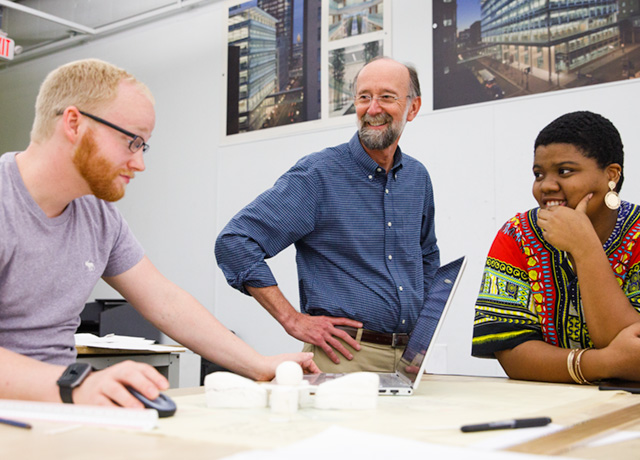
“As a young kid, maybe 9 or 10, I would sketch house ideas and build models to visualize the designs,” he recalls. “The models were made from toothpicks and Elmer’s glue. Nothing fancy, but using toothpicks allowed me to create a variety of shapes.”
He even improvised materials. Pencil shavings mixed with glue became “terrazzo” floors. Eventually, those early experiments evolved into model kits and, of course, LEGO sets. What began as childhood curiosity grew into something much bigger: a lifelong passion for architecture.
By the time he reached college, Fuller knew he wanted to pursue architecture as a career, to shape the environment in which people live, work, and learn. He spent time as a professional architect in Pennsylvania, Connecticut, and Missouri, experience that would later inform his work as a faculty member, and then a department chair, in the architecture program at the University of Hartford.
Now Fuller is looking back as he prepares to retire this spring. “My earlier dreams were amazingly fulfilled through 47 years of practice, including the last 31 years teaching,” he says.
Building from the Ground Up
When Fuller arrived at UHart in 1995, the architecture program was only four years old—the second program of its kind in Connecticut. “The excitement to be part of a program that was just starting, that’s what stands out most,” he says. “We were energized to provide a high-quality, accessible, and practice-based program for a diversity of students in Connecticut and the surrounding states.”
Evolving with the Profession
Over the years, especially during his time as chair, Fuller played a key role in shaping a program that reflects the complexity and breadth of architectural practice. “We revised the undergraduate curriculum to provide students with a broad base covering all aspects of architecture as a profession,” he explains. “including expanded theory, design, and structural engineering courses. We also created new pathways for students to stay on track, including offering summer design studios.”
We expanded study abroad opportunities, and created Track 1 and Track 3 Master of Architecture programs. Track 1 allows our own undergraduate students to complete their MArch. in one additional year. Track 3 is a path for students who do not have an undergraduate architecture degree.
Just as important as curriculum, however, has been the program’s growth in enrollment. “The enrollment growth has been a team effort,” Fuller emphasizes, crediting the work of Maggie Hayes, Manager of College Admission, and student ambassadors. “Having potential students talk with our current students creates the sense that they can see themselves here, that they belong —and that’s a primary reason for our growth.”
A Student-Centered Legacy
Ask Fuller what matters most, and his answer comes quickly: the students. “Seeing an 18-year-old, nervous and shy, and then watching them grow, struggling, having moments of enlightenment, and then confidently walking across the commencement stage. It’s an amazing feeling.”
That transformation is at the heart of his teaching philosophy. “I hope students leave with a solid understanding of the profession and how they see themselves in it,” he says. “I tell my students to be proud of your achievements, but also be humble. Never stop learning.”
Jim Fuller, Architecture Department ChairI hope students leave with a solid understanding of the profession and how they see themselves in it. Be proud of your achievements, but also be humble. Never stop learning.
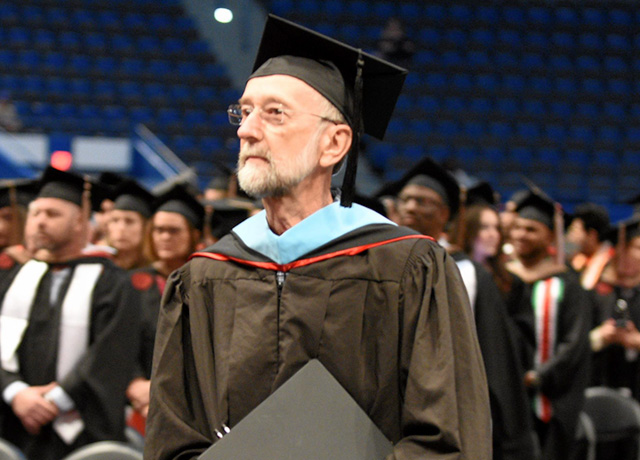
It’s a lesson he has taken to heart himself. “New ideas can come from anywhere,” Fuller says. “New technology, new pedagogy, new approaches to design. I learn from so many different sources, including my students.”
More Than a Classroom
Beyond teaching, Fuller has played an active role across the University over the years, including serving as: University Marshal; chair of the Faculty Senate; CETA Chief Marshal; and Chair of the CETA Promotion, Tenure, and Academic Freedom committee. In addition to his UHart leadership roles, he served as President, Vice-President, and Commissioner of Design for the American Institute of Architects/CT chapter, Co-Chair of the Board of Directors for MakerspaceCT and served on the Board of Directors for the Construction Institute. “All these experiences taught me a great deal about the importance of working together to achieve results,” he says.
That spirit of collaboration extends into the architecture program itself. “What makes the UHart architecture community unique is the diversity of students, and the way that diversity is embraced,” Fuller says. “It creates a community of learners who share different perspectives.”
Looking Ahead
Fuller knows exactly what he’ll miss most in retirement. “The students,” he says without hesitation. “The rush of energy and excitement every August as new students arrive and returning students fill the studios.”
But he doesn’t plan to slow down. “We plan to travel,” he says. “And I have a lot of reading, writing, and drawing I’ve postponed for many years.” He’s also beginning research for a potential book about World War II communications supporting the airlift over the Himalayans, an effort inspired by his father’s service, “on loan” from AT&T to the Air Force. “It’s a way to pay respect to my dad and all the others who served,” he says.
Architecture, too, will remain part of his life. “I don’t know exactly how,” he says, “but I’d enjoy staying involved, perhaps serving on juries reviewing student projects.”
A Lasting Impact
Fuller says he looks back on his 31 years at UHart with great satisfaction and joy. “Seeing students’ achievements, while also being challenged by new roles and responsibilities … I could not have dreamed of the opportunities the University has provided me. I am very grateful.”
And there’s one final, simple piece of advice he leaves behind: “Be humble. Be inquisitive. Be respectful. Be inclusive. Listen.”