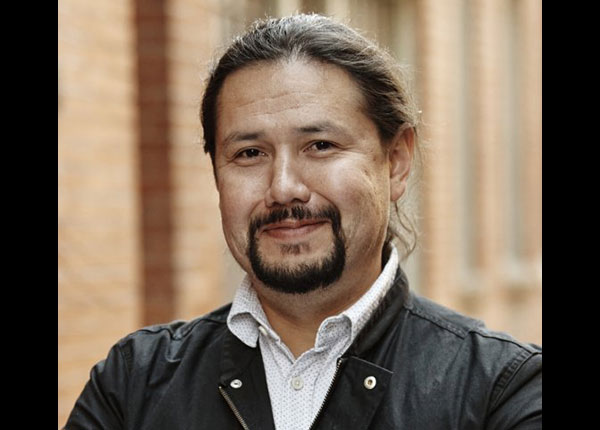
Guided by his UHart experience, alumnus Joseph Kunkel ’06 is shaping sustainable futures for Indigenous communities worldwide.
Toward the end of his high school career, while deciding where to attend college, Joseph Kunkel ‘06 faced a challenge. As a member of the Northern Cheyenne nation, Kunkel had two primary career interests —architecture and engineering—one of which he intended to pursue on behalf of the Native American community. He didn't know where to turn for help in exploring both fields. Then, during his research, he discovered the College of Engineering, Technology, and Architecture at the University of Hartford.
It felt almost as if he had engineered this opportunity himself.
Kunkel, whose mother was a nurse and whose father worked for the New Jersey state government in its housing division, grew up in a modest-sized municipality in New Jersey. This background made him appreciate the small-town vibe of the UHart campus and the surrounding West Hartford community. It didn't hurt that he quickly formed a tight-knit group of friends, found a passion for playing on the tennis team, and received a scholarship. Once academics began, Kunkel found that his professors were particularly skilled at forecasting what the professional future could hold for someone like him. They also excelled at suggesting academic and post-academic pathways to help him find his ultimate niche.
“I remember them well to this day, 19 years later—people like Professors James Fuller and Daniel Davis. I still recall Professor Fuller's Means & Methods course as if it were yesterday.” Fuller is currently the chair of the architecture department.
Kunkel received his undergraduate degree from UHart in 2006 and his master's at the University of Maryland in 2009.
Today, as a senior executive with the award-winning MASS Design Group based in Santa Fe, New Mexico, he directs a lab focused on sustainable native community designs.
Kunkel began his career in corporate architecture before working on affordable housing initiatives, similar to his father's work in New Jersey. After that, he established a nonprofit foundation for sustainable native communities, leading him to his current role at MASS Design Group.
“It was an unconventional path that got me here,” he admits, “but it makes a lot of sense to me. It’s challenging—but I thrive on those challenges.”
MASS, which stands for Model of Architecture Serving Society, was founded on the principle that architecture's influence extends beyond individual buildings and plays a critical role in supporting communities that need to balance history with current needs. Today, MASS has a team of over 100 architects, landscape architects, engineers, builders, furniture designers, writers, filmmakers, and researchers representing 20 countries around the world.
In 2018, Kunkel received a Rauschenberg SEED grant from the Robert Rauschenberg Foundation to expand his work in community development-based art. The following year brought him two more honors: a Creative Capital Award for his work on the Northern Cheyenne Healing Trail and an Obama Fellowship in recognition of his contributions to Indigenous communities.
MASS has garnered its own impressive accolades, including the American Institute of Architects Award, the Architecture Innovator of the Year from the Wall Street Journal, a ranking as number four in Architect Magazine's “Top 50 Firms in Design; and a National Design Award in Architecture from the Cooper Hewitt/Smithsonian Design Museum.
“In tribal communities, sustainability has different meanings,” says Kunkel. “For one tribe, it might mean cultural sustainability, while another might define it as access to community resources or new opportunities for its people.” That's why his professional life cannot be easily pigeonholed into a single description. His roles and goals with the MASS Design Group are as broad as they are vital.
“I always ask the people we meet with, ‘How can we support your vision?" Then I plan meetings with tribal leaders, CEOs, and other business and community managers, create proposals, put together teams, and check on the teams—a plethora of projects,” he concludes in his modest, soft-spoken way—a personal style that belies the complexity and significance of his work and his capacity to effect positive change.
Joseph Kunkel ’06, College of Engineering, Technology, and Architecture alumnusIt was an unconventional path that got me here, but it makes a lot of sense to me. It’s challenging—but I thrive on those challenges.