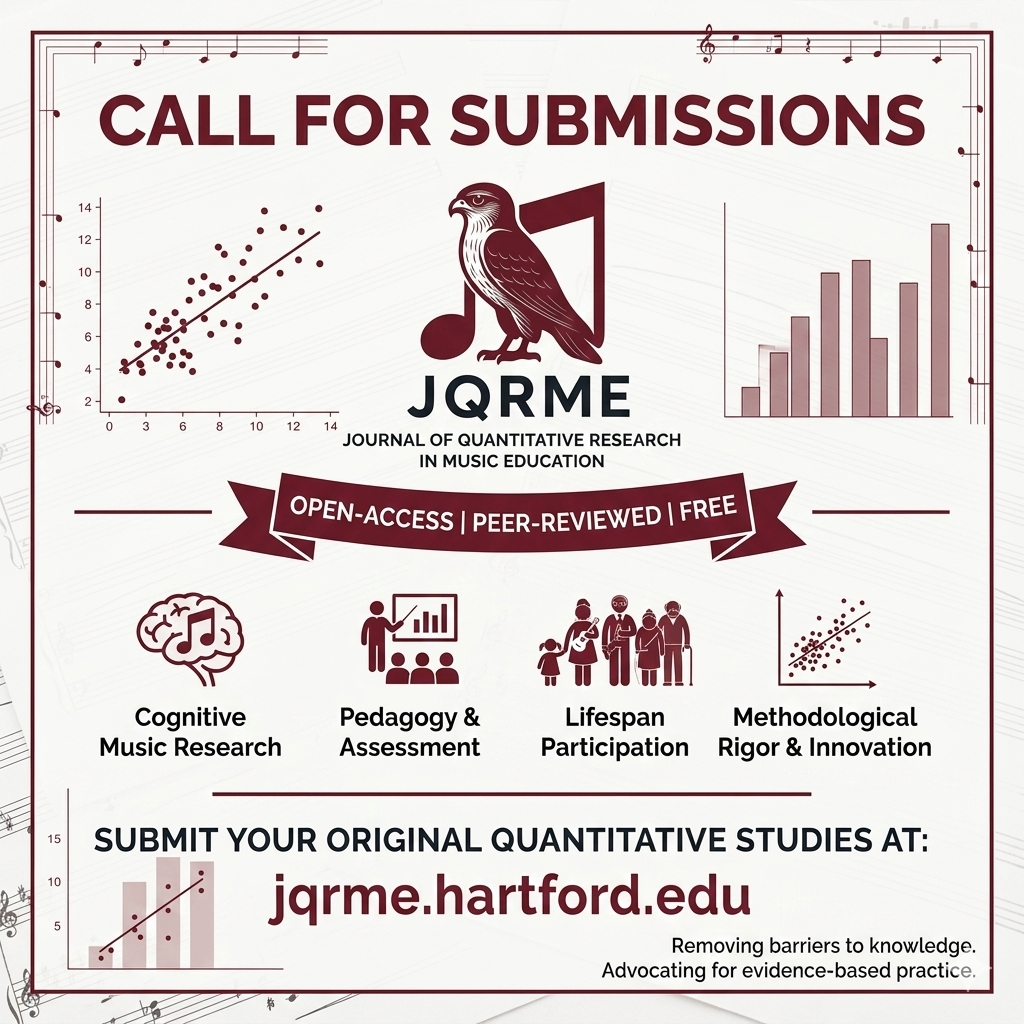
Submissions are encouraged for the Jounral of Quantitative Research in Music Education. Many of Hartt's music education faculty helm the editorial committee.
More information can be found on the journal's website here.
About the Journal
Mission Statement: The Journal of Quantitative Research in Music Education is dedicated to advancing the understanding of music teaching and learning through the publication of rigorous, data-driven research. Encompassing topics across the full spectrum of music education—from early childhood through lifelong learning—the journal provides a scholarly forum for studies employing quantitative methodologies to investigate pedagogy, performance, cognition, assessment, policy, and participation in diverse musical contexts. As a free, peer reviewed and open-access publication, the journal is committed to removing barriers to knowledge and ensuring that high-quality research is available to all scholars, educators, and practitioners worldwide. By promoting methodological integrity, transparency, and innovation, the Journal of Quantitative Research in Music Education seeks to strengthen the empirical foundations that inform music education theory and practice globally.
Aims and Scope: The Journal of Quantitative Research in Music Education (JQRME) publishes high-quality, data-driven studies that advance understanding of music teaching and learning across the lifespan—from early childhood through lifelong participation. The journal’s primary aim is to strengthen the empirical foundations of music education by promoting rigorous, transparent, and replicable quantitative research.
JQRME welcomes original investigations employing diverse quantitative methodologies, including descriptive, correlational, causal-comparative, experimental, quasi-experimental, and mixed-methods designs with a quantitative emphasis. Studies may address topics such as:
- Music learning and cognition
- Instructional practices and pedagogy
- Assessment, evaluation, and measurement
- Motivation, self-efficacy, and affective outcomes
- Curriculum and policy analysis
- Access, equity, and participation in music education
- Teacher education and professional development
- Community, informal, and lifelong music engagement
We welcome studies of all scales, including pilot studies and exploratory work that contribute valuable insights to the field. Submissions should adhere to the stylistic and formatting conventions of the Publication Manual of the American Psychological Association (7th edition). Manuscripts must not exceed 10,000 words in total length, including the title page, abstract, tables, figures, references, and appendices.
The journal invites submissions that employ sound statistical procedures, innovative analytic approaches, and robust design principles to generate evidence that informs theory, research, and practice in music education. JQRME serves researchers, practitioners, policymakers, and graduate students seeking to deepen the field’s empirical understanding of how individuals learn and engage with music in educational and community settings.
The journal accepts submissions on a rolling basis and will catalogue the published articles each year in a searchable and indexed volume.
Editorial Team
Editor: Joshua A. Russell, PhD
Associate Editor: Birce Tanriguden, PhD
Graduate Student Journal Managers: Hamid Niknampour, Anastasia Rege, Xiaoyuan Ma
Editorial Review Board: